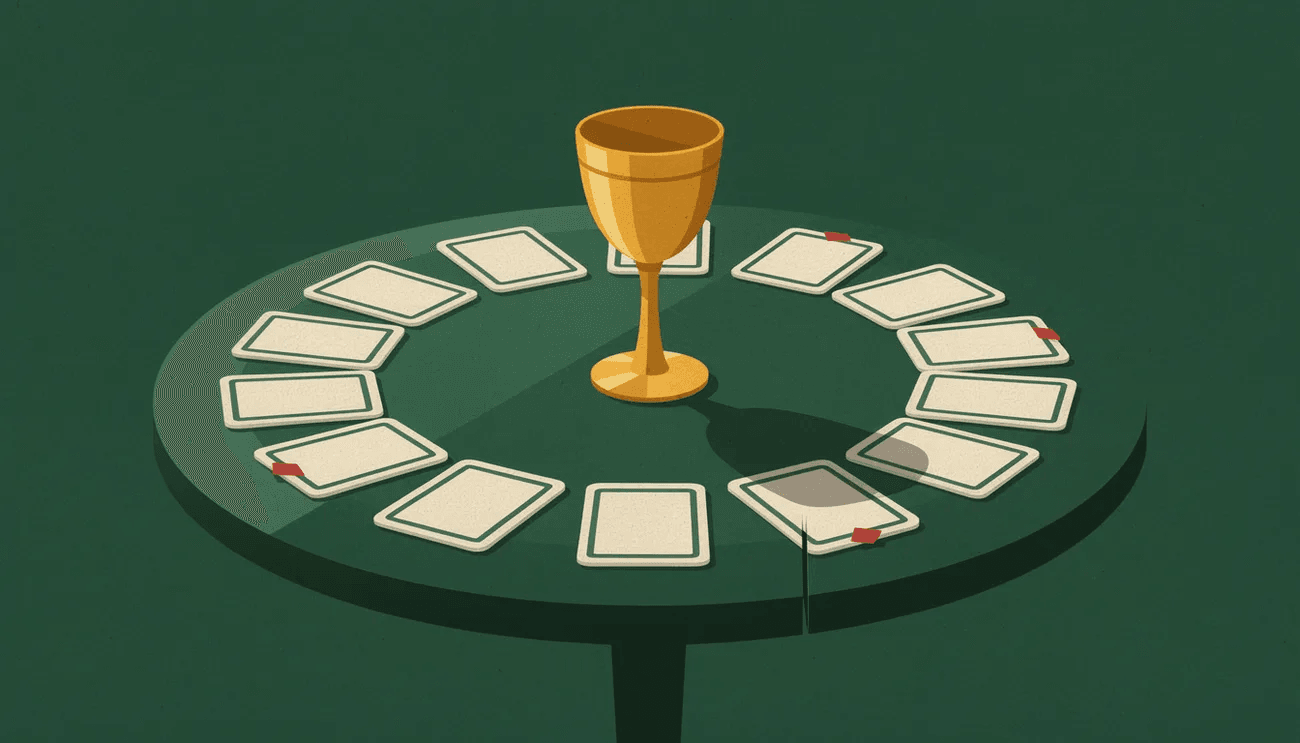
Horse Race
Also called Racing Aces, Horserace, Ace Race
By Emma Lily Carter · Updated
- Players
- 3 to 12
- You need
- Cards
- Buzz
- Medium
- Time
- About 15 min
Rules in 30 seconds
The four Aces line up as horses, every player bets a number of drinks on a suit, and the dealer flips cards one at a time to move the matching horse up the track. Back the winning horse and you hand out double your bet; back a loser and you drink it.

Horse Race is the drinking card game where nobody plays a card. The four Aces are horses, the dealer is the commentator, and everyone else is at the rail with a bet. You choose a suit, wager a number of drinks, and then watch a deck decide whether you are giving those drinks away or taking them. One race lasts about five minutes, which is why it usually becomes six.
What you need
- A full deck of 52 cards
- A table long enough for a row of four cards and a column of seven beside it
- A drink per player, measured in sips or fingers so bets mean something
- One player willing to do the voice of a race announcer
Setup
- Pull the four Aces and lay them face up in a row at one end of the table. These are the horses in the starting gate. Leave a finger of space between them.
- Deal seven cards face down in a column running away from the Aces. Place them along one side of the row, so the layout looks like an L. These are the track markers, and they stay face down for now.
- Choose a dealer. They flip the cards, move the horses, and call the race. The dealer does not bet, which is either a privilege or a punishment depending on the table.
- Agree on the unit. One bet equals one sip, one finger, or one second of drinking. Decide now, not after someone bets twenty.
How to play Horse Race
- Every player bets on a suit and says how many drinks they are betting. “Five on hearts.” Bets can be any size, and the dealer keeps a tally if the table is big.
- Drink half your bet before the race starts. Bet six, drink three now. This is the stake and it is what stops people betting fifty.
- The dealer flips the top card of the deck and calls the suit. The Ace of that suit moves forward one space, level with the first track card. Only the suit matters, never the rank.
- Keep flipping and moving, one card at a time. The dealer narrates. “Spades takes the lead, clubs has not left the gate.” This is most of the game.
- When every horse has passed a track card, turn that card over. The Ace matching its suit moves back one space. A horse that is still in the gate stays in the gate. Then keep flipping from the deck.
- The first horse past the last track card wins. Stop flipping. The order the others are in decides place bets if you made any.
- Settle up. Winners hand out twice their bet to anyone they like, split however they want. Losers drink the half of their bet they have not drunk yet. Reshuffle and run the next race.
Betting table
The win bet is the standard game. The rest are common add-ons borrowed from the racetrack; the payouts below are what we use, so agree on yours before the first flip.
| Bet | You pick | Up front | If it hits | If it misses |
|---|---|---|---|---|
| Win | One suit to finish first | Drink half your bet | Hand out double your bet | Drink the other half |
| Place | One suit to finish first or second | Drink half your bet | Hand out your bet | Drink the other half |
| Exacta | First and second, in order | Drink half your bet | Hand out four times your bet | Drink your full bet |
| Trifecta | First, second, and third, in order | Drink half your bet | Hand out eight times your bet | Drink your full bet |
| Longshot | The suit currently in last place, bet mid-race | Drink your full bet | Hand out triple | Nothing more |
A trifecta with four horses is a one-in-24 guess, so an eight-times payout is still a bad deal. People make it anyway.
Variations and house rules
- Longer track. Ten track cards instead of seven. Setbacks hit more often and a horse that leaves the gate first can still finish last, which is more like real racing and more drinking for the dealer’s voice.
- Early setback. The version on Wikipedia flips a track card the first time any horse reaches it, not when the last one passes it. Setbacks come sooner and the leader eats most of them.
- Stumble. Leave the jokers in. When one is flipped, every horse except the leader moves forward one space.
- Double leap. Two cards of the same suit in a row moves that horse two spaces on the second card. Rewards the dealer for flipping fast.
- Odds board. Deal the track cards face up instead. Before betting, count the suits showing: a suit with three of its cards on the track is going to be set back a lot, so the table can offer longer payouts on it.
- Dealer drinks. The dealer drinks one every time a horse is set back. It keeps the person with the safest job honest.
- Auction. Instead of betting, auction each horse in drinks to the highest bidder. The owner of the winner hands out the total pot.
Tips
- Cap the bet at ten. The game stays fun when a loss is five sips, not a full drink, and a winner who hands out twenty drinks ends the night for somebody. A cap also keeps the “half up front” rule from being a problem for whoever is already behind.
- Give the dealer a script. “They’re off” at the first flip and a shout for every lead change. A quiet Horse Race is just watching someone turn over cards.
- Play it between bigger games. It takes five minutes, needs no setup past pulling the Aces, and resets the table between rounds of Kings Cup or Bus Driver.
- Sit so everyone can see the track. People will argue about which horse is ahead, and the only fix is a clear view of the cards.
Horse Race, answered
How many cards make up the track in Horse Race?
Seven face-down cards is the common length, which gives a race of a few minutes. Use five for a sprint or eight to ten if you want the setbacks to matter. The track length changes the game more than any other rule.
Do you drink your bet before the race or after?
Both, in the common version. You drink half your bet when you place it and the other half if your horse loses. If your horse wins you hand out double your bet and drink nothing more.
Can you bet on more than one horse?
Yes, as separate bets, each paid up front. Betting on two horses halves your chance of drinking the full loss but doubles what you drink at the start, which is exactly the trade a bookmaker would want you to make.
What happens when a track card is flipped?
Once every horse has moved past a track card, the dealer turns it over. The Ace matching its suit moves back one space. A horse still in the gate cannot go backwards.
What if the deck runs out before a horse finishes?
Shuffle the flipped cards and keep going. With a seven-card track it almost never happens; if it does, the dealer drinks one for making it this far.
Worth having
Affiliate link. We may earn a commission, at no cost to you.
Hoyle waterproof playing cards
Clear plastic, rinses clean. Every card game here ends with a spill.
Popular with players this week
Affiliate links. We may earn a commission, at no cost to you.
If you liked this

Please drink responsibly. Pace yourself, drink water between rounds, look after each other, and never drive after playing.