
Korean Drinking Games
Also called Soju drinking games, Korean party games, K-drama drinking games, Korean soju games
By Emma Lily Carter · Updated
- Players
- 2+
- You need
- Nothing
- Buzz
- Medium
- Time
- About 1 h
Rules in 30 seconds
Ten Korean drinking games explained in a paragraph each, with quick rules and links to the full pages, from 3-6-9 and Baskin Robbins 31 to Titanic, the Image Game, the Nunchi Game, and the Apartment Game. Almost none of them need anything but a table, a bottle of soju, and the people around it.
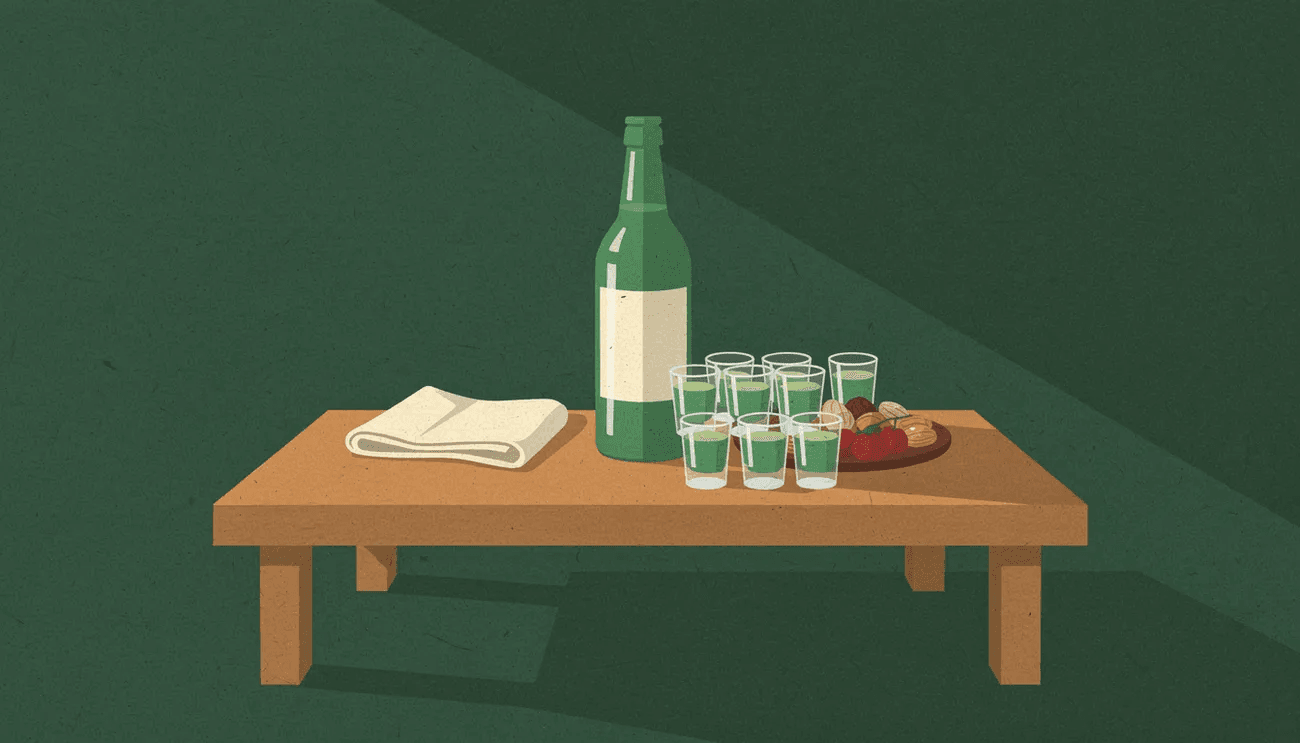
Korean drinking games come from tables, not living rooms. They were worked out at university retreats and company dinners, in barbecue restaurants and tent bars, where the only equipment was a bottle of soju, a few small glasses, and the people around the table. So the games use counting, rhythm, reflexes and pointing, and the bottle supplies the penalty. That makes them the most portable drinking games without cards there are: every game below except Titanic can be played in a queue. The list starts with the two counting games every Korean knows, moves through the reflex and voting games, then covers how a soju night actually runs, including the etiquette that matters if you are playing with Koreans.
3-6-9 (Sam Yuk Gu)
The Korean drinking game. Everyone counts up from 1 around the circle, and any number containing a 3, 6, or 9 is clapped instead of spoken. The count speeds up, the claps pile up in the thirties, and the first person to say a number out loud that should have been a clap, or clap when they should have spoken, drinks. It takes ten seconds to explain and an hour to get good at. The full rules, the double-clap question, and the variations are on the 3-6-9 page.
- Count up from 1, one number per player, around the circle
- Any number containing a 3, 6, or 9 is a clap, not a word
- Numbers with two of those digits (33, 36, 39, 63, 66, 69) get two claps
- Speak a number you should have clapped, clap one you should have spoken, or hesitate, and you drink
- The loser restarts the count from 1
Baskin Robbins 31
The other counting game, and the one with a strategy. Players count up from 1 and each person says one, two, or three numbers on their turn. Whoever is forced to say 31 drinks. It is named after the ice cream chain and its 31 flavours. With two players there is a forced win for whoever says 2 first; with more players, the last ten numbers become a negotiation. The winning numbers and the 41 and backwards versions are on the Baskin Robbins 31 page.
- Count up from 1, in turn order
- Say one, two, or three numbers per turn; you cannot skip or repeat
- Whoever says 31 drinks and starts the next round
- To win with two players, land on 2, 6, 10, 14, 18, 22, 26, and 30
Titanic
The soju bomb game, and the only one on this list that needs a glass. Float an empty shot glass in a glass of beer. Players take turns pouring a little soju into the floating glass, and whoever’s pour sinks it drinks the whole thing, beer and soju together. A drop counts as a pour, which is where the skill is. It is best as a set piece, once or twice a night, not a loop. Setup and the glass-size notes are on the Titanic page.
- Fill a glass half to two-thirds with beer and float an empty shot glass on it
- Take turns pouring soju into the shot glass; any amount counts, and everyone must pour
- Whoever’s pour sinks the shot glass loses
- The loser drinks the whole glass
Image Game
Korea’s Most Likely To, with no discussion. One player describes a type of person (“most likely to fall asleep at the club”), the table counts to three, and everyone points at once. Whoever has the most fingers pointing at them drinks and asks the next question. If you know the description is you, cross your arms in an X on the count; if you were right, the people who pointed drink instead. The block rule and the chopstick version are on the Image Game page.
- One player says a description
- On three, everyone points at one person at the same time
- Most fingers drinks; ties all drink
- The person who drank asks the next question
- Block with crossed arms if you think it is you; a correct block makes the pointers drink, a wrong one makes you drink
Nunchi Game
Nunchi means reading a room, and the game tests exactly that. There is no turn order: the count starts at 1, and any player can stand and say the next number the moment they judge that nobody else will. Two people who call the same number at once both drink. If the count gets all the way round without a collision, the last person who never spoke drinks for being too slow. The quietest game in the set and one of the most tense. Full rules and the count-to-21 version are on the Nunchi Game page.
- Someone says “Nunchi game, start” and the table goes quiet
- Anyone stands and says “1”, then anyone else “2”, and so on, one number per player
- Two people on the same number at the same time both drink; the round restarts
- If the count completes, the last person left sitting drinks
Apartment Game
The hand-stacking game behind “APT.” by Rose and Bruno Mars. Everyone chants “apateu, apateu”, then piles both hands in the middle in any order. The leader calls a floor number. On each count the lowest hand in the pile comes out and lands on top, so the building grows a floor at a time, and whoever’s hand moves on the called number drinks. Rose has said it is her favourite drinking game, and since the song came out in October 2024 it has been the Korean game everyone outside Korea asks about. The floor-counting table and the reverse version are on the Apartment Game page.
- Chant “apateu, apateu” and stack everyone’s hands in a pile
- The leader calls a number
- Each count, 1, 2, 3 and up, sends the lowest hand to the roof
- Whoever’s hand moves on the called number drinks and leads the next round
Bunny Bunny (토끼토끼)
A rhythm and reflex game that is mostly about not laughing. Players hold their hands up at their mouth like a rabbit nibbling a carrot. The starter says “bunny bunny” to themselves, then “bunny bunny” again while pointing both hands at another player. That player immediately does the same and passes it on, and the two people either side of whoever is being pointed at say “dang-geun, dang-geun” (carrot, carrot). Miss your cue, say the wrong word, or break the beat, and you drink. Regions disagree on who says which word, so agree before you start.
- Everyone makes rabbit hands at their mouth
- The player with the turn says “bunny bunny” twice, the second time pointing at someone
- The person pointed at takes the turn straight away and passes it on
- The two players beside the target say “dang-geun, dang-geun”
- Late, wrong, or frozen, you drink
Cham Cham Cham (참참참)
A two-person reflex duel that the whole table can rotate through. One player holds a hand flat in front of the other’s face and says “cham, cham, cham”. On the third “cham” they swing the hand left or right, and at the same moment the other player turns their head left or right. If the head goes the same way as the hand, the turner loses and drinks. Turn the other way and you swap roles. It is also a common way to decide who drinks in another game, instead of arguing.
- Two players face each other, one with a hand held up flat
- The hand player says “cham, cham, cham” and swings left or right on the third
- The other player turns their head left or right at the same moment
- Same direction, the head player drinks; different direction, swap roles
- Moving before the third “cham” counts as a loss
Bomb Game (폭탄게임)
Also called the 007 game, and the best one for a big table. The starter points at someone and says “zero” (gong). That person points at someone else and says “zero”. The next says “seven” (chil), the next says “bang” and points, and whoever receives the “bang” says nothing: the two people sitting either side of them throw their hands up and shout. Anyone who says the wrong word, points late, or fails to react when the bomb lands next to them drinks. You can point at yourself with a thumb at any step, which is how the good players set traps.
- Pass “zero, zero, seven, bang” around the table by pointing
- Whoever receives “bang” stays still and silent
- The two players either side of them throw their hands up and shout
- Wrong word, late pass, or a missed reaction means a drink
- Pointing at yourself is allowed and is the main tactic
Soju bottle cap flick
The game that happens as soon as a new bottle is opened. Twist the metal cap off a soju bottle; the strip of metal that was the tamper band stays attached. Twist the strip so it sticks out like a tail, then pass the cap around the table with each player flicking the tail once. Whoever flicks it off drinks, or in the most common version, the players either side of the one who flicks it off drink. It is often played with the number printed inside the cap as a bonus round of higher or lower.
- Open a soju bottle and twist the cap’s metal strip into a tail
- Pass the cap round, each player flicking the tail once
- Whoever’s flick snaps it off loses; on many tables the two neighbours drink instead
- Bonus round: the winner reads the number inside the cap, and the table guesses it with “higher” or “lower” clues
How to host a Korean drinking night
A Korean drinking night runs on a few habits that make the games above work. You do not need all of them, but the table will feel more like the real thing with three or four.
- Start with food. Koreans do not drink without anju (안주), the food on the table. Barbecue, fried chicken, or a plate of anything salty keeps the games going past the second bottle.
- Soju in small glasses, finished in one. The standard soju glass holds about 50 ml. The first glass of the night is usually drunk in one, with a “geonbae” (건배) from the table. After that, sip or shoot as you like; the games set the pace.
- Somaek. Soju and beer mixed in one glass. The usual ratio is roughly 3 parts soju to 7 parts beer. Tap a spoon or chopstick against the glass, or drop the glass on the table from a few centimetres, to foam it up. It is the house drink for most games because the penalty is a few sips rather than a shot.
- Poktanju, the soju bomb. A shot glass of soju dropped into a glass of beer and drunk straight down. The older version uses whiskey. Titanic makes one by accident; everywhere else, make one on purpose and share it.
- Pour for others, never for yourself. Your glass gets filled by the people next to you, and you fill theirs, only when the glass is empty. Topping up a half-full glass is a small rudeness.
- Two hands. When pouring for someone older or senior, hold the bottle with both hands, or support your pouring arm at the elbow with the other hand. Receive a drink the same way, with two hands on the glass.
- Turn away to drink. With an elder at the table, turn your head or body slightly away from them when you drink. It is a sign of respect, and nobody will expect a visitor to know it, which is why doing it lands so well.
- Keep the penalties small. At a Korean table the loser’s drink is a soju glass, not a beer. The games are fast and someone loses every round. A night of 3-6-9 and the Apartment Game is ten or fifteen losses each, and at one glass a time that is plenty.
Tips
- Run the games in a set: a counting game, then a reflex game, then a voting game. Each one uses a different part of the brain, so the table does not burn out on one skill.
- Learn Korean numbers for 3-6-9 and Baskin Robbins 31. Il, i, sam, sa, o, yuk, chil, pal, gu, sip. Playing in Korean slows everybody down by the same amount and is the best part of the night for anyone who does not speak it.
- Put water on the table from the start, and leave it there. Soju is around 17 percent, the glasses are small, and the games are quick, which is a combination that creeps up on people who are used to beer.
- Save Titanic for last. It needs a fresh beer each round and produces one big drink at a time, which is the right size for a finish and the wrong size for a start.
Korean Drinking Games, answered
What is the most popular Korean drinking game?
3-6-9 is the one every Korean knows, and Baskin Robbins 31 is a close second. Both are counting games that need nothing and take ten seconds to explain. Since 2024 the Apartment Game has been the one foreigners ask about most, because of the song APT. by Rose and Bruno Mars.
How do you play Korean drinking games without speaking Korean?
Most of them translate directly. Count in English for 3-6-9, Baskin Robbins 31 and the Nunchi Game, ask the Image Game questions in English, and keep the chants for the Apartment Game and Bunny Bunny as they are, since they are two words each. The only game that needs Korean is the Korean consonant word game, which this list leaves out.
What do Koreans drink during drinking games?
Soju, usually, served in small glasses and drunk in one. Beer is the other half of the table, and the two are mixed into somaek, or dropped together as a soju bomb. The losing drink in most games is one soju glass, not a full beer.
What is a soju bomb?
A shot glass of soju dropped into a glass of beer and drunk straight down. The Korean name is poktanju, which means "bomb drink". The Titanic game is built around making one by accident.
How many people do you need for Korean drinking games?
Two is enough for Baskin Robbins 31 and Titanic. The rhythm and pointing games (3-6-9, Bunny Bunny, the Image Game, the Apartment Game) want at least four, and the Nunchi Game is best with six or more. None of them have an upper limit.
Why do Korean drinking games need no equipment?
Because they were invented at restaurant tables and university retreats, where the only things to hand were glasses, a bottle and the people sitting there. So the games use counting, rhythm, reflexes and voting, and the bottle supplies the penalty.
Popular with players this week
Affiliate links. We may earn a commission, at no cost to you.
If you liked this

Please drink responsibly. Pace yourself, drink water between rounds, look after each other, and never drive after playing.